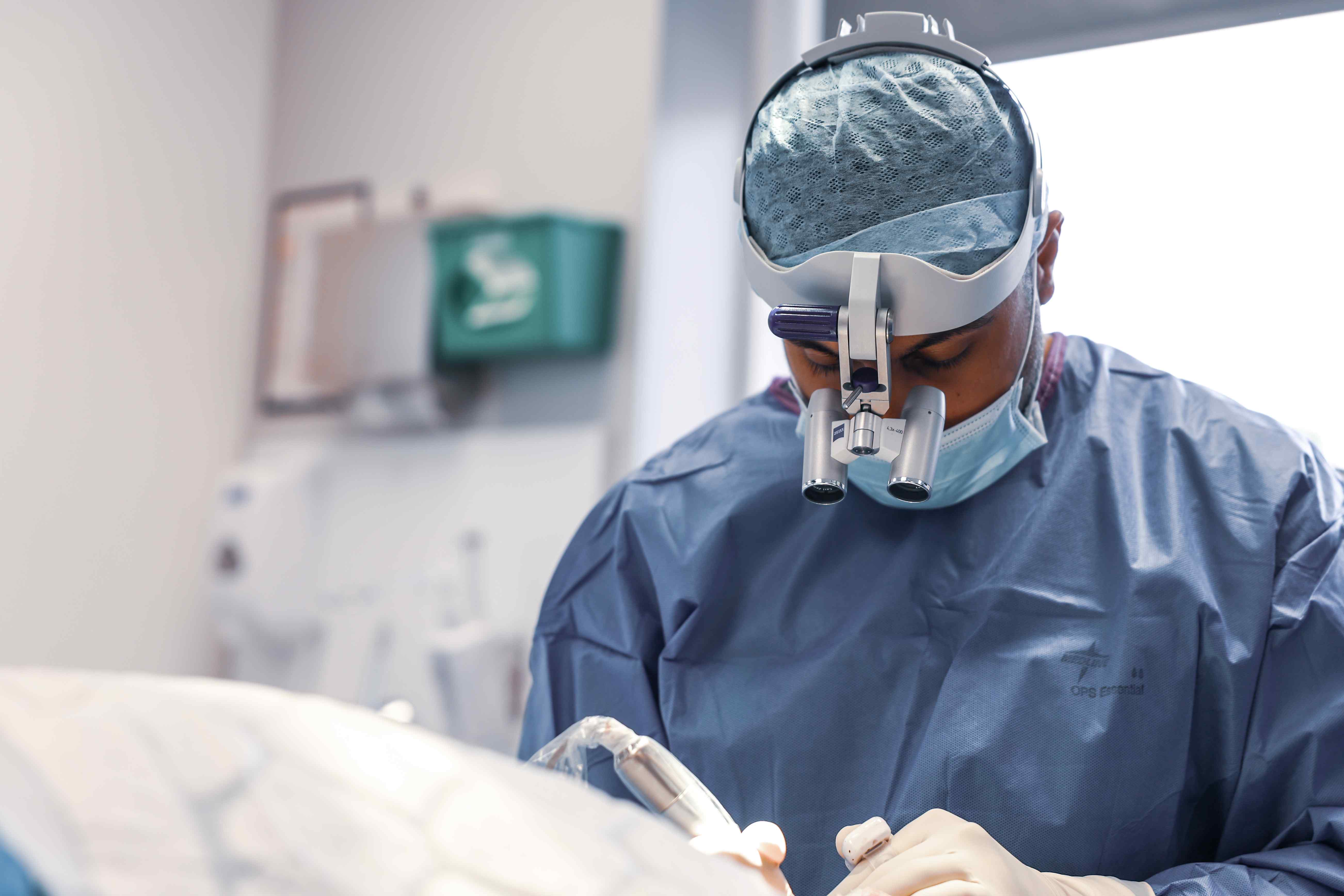
FUE hair transplant

Joe Hart Hair Transplant: The Story Behind a Result That Kept a Nation Guessing
For more than a year, there was speculation. Now, Joe Hart and Dr Furqan Raja have revealed the answer for the first time.
Former England and Manchester City goalkeeper Joe Hart underwent an FUE hair transplant with Dr Furqan Raja and his surgical team in May 2025.
Until now, that detail had remained entirely private.
There had been photographs. There had been headlines. And there had been plenty of discussion surrounding Joe Hart’s hair transplant as his appearance began to change through 2025 and into 2026.
What nobody knew was who had performed it.
That was by design.
More than a year after his procedure, and only with Joe’s agreement, Joe Hart and Dr Raja Hair Restoration have now publicly revealed the story for the first time.
The speculation around Joe Hart’s hair transplant
Joe Hart has spent much of his adult life in front of cameras.
As England’s long-standing number one goalkeeper, a two-time Premier League champion with Manchester City and, more recently, a familiar face in football broadcasting, changes in his appearance were always likely to be noticed.
Hair, perhaps more than for most footballers, had also been part of Joe’s public image. At the height of his playing career, he famously appeared in advertising campaigns for Head & Shoulders.
So when Joe appeared in the summer of 2025 with his hair cut considerably shorter, people paid attention.
The timing was particularly notable around Soccer Aid in June 2025, when photographs of Joe prompted widespread discussion about whether he had recently undergone a hair transplant.
The speculation continued.
Football supporters discussed it on social media. Newspapers picked up the story. Hair transplant websites analysed photographs and offered theories about what he might have had done.
Some correctly suspected that a procedure had taken place.
But there was one question nobody seemed able to answer:
Who performed Joe Hart’s hair transplant?
For more than a year, there was no answer.
Joe Hart reveals Dr Raja as his hair transplant surgeon
We can now confirm that Joe Hart’s hair transplant was performed by Dr Furqan Raja and his surgical team in May 2025.
Joe underwent an FUE — Follicular Unit Extraction — hair transplant, with the procedure planned around a simple principle: to improve his hair while retaining an appearance that remained entirely his own.
The story was finally made public in August 2026, when Dr Raja shared a film documenting Joe’s journey and the result of his procedure.
Joe responded personally to the announcement from his official Instagram account:
“Nailed it @thedrraja thank you” — @joehartofficial
A short comment, but perhaps the most fitting conclusion to a story that had generated more than a year of speculation.
In the film itself, Joe was equally direct about why he had chosen the clinic:
“It’s always nice to have the top man doing the work.” — Joe Hart
It is a telling remark, and it points to something real. Dr Raja’s practice has grown largely by word of mouth, and a good deal of that has travelled through football, broadcasting and entertainment — circles where discretion is expected and reputations are passed on quietly rather than advertised.
For a long time, almost none of those patients said anything publicly. That is beginning to change. A growing number of well-known patients now feel comfortable talking openly about having had a hair transplant — and about who performed it.
Joe Marler is one of them. The former England rugby international has spoken publicly about the hair transplant he had with Dr Raja, and has since become one of the most visible faces on British television — appearing on The Celebrity Traitors, interviewing Prince Harry, and joining Gladiators as its first celebrity Gladiator.
Joe Hart is the latest — and, in football terms, the most recognisable yet.
Until that moment, the identity of Joe Hart’s hair transplant surgeon had remained private. His appearance had been discussed across social media and in the press; photographs had been scrutinised, theories circulated and clinics speculated about.
Throughout it all, neither Dr Raja nor the clinic disclosed that Joe was a patient.
Only when Joe was ready to share the story was that relationship made public.
That is precisely how it should be.
More than a year of complete discretion
High-profile patients inevitably attract curiosity.
For a professional footballer, actor, broadcaster or other public figure, even a relatively ordinary appointment can attract attention. A procedure that temporarily changes somebody’s appearance can attract considerably more.
But medical confidentiality does not become negotiable because somebody is well known.
Joe’s treatment was approached in exactly that way.
There were no hints from the clinic. No photographs were released. No attempt was made to capitalise on the speculation surrounding his appearance.
And at no point during the considerable public discussion about Joe Hart’s hair transplant did the clinic disclose that he was a patient.
The story was Joe’s to tell.
The fact that the procedure took place in May 2025 and remained private for more than a year is perhaps a more meaningful demonstration of discretion than any claim a clinic could make about it.
For some patients, sharing their result is something they enjoy.
For others, the greatest compliment is that nobody ever knows they came through our doors.
Both deserve exactly the same respect.
“Unbelievable transplant… give me the name of that surgeon”
There was, however, one particularly memorable reaction along the way.
As Joe’s hair developed, his public appearances continued to attract attention — and increasingly, compliments.
During a discussion on The Good, The Bad & The Football, Paddy McGuinness admired Joe’s result before delivering a line that, in hindsight, proved particularly well timed:
“Unbelievable transplant… give me the name of that surgeon.” — Paddy McGuinness
At the time, the answer was still a closely held secret.
There is something fitting about that reaction.
A natural hair transplant should invite compliments about the person rather than questions about the procedure.
The work should not be the first thing somebody sees.
The thinking behind Joe Hart’s hair transplant
No two hair transplants should be identical.
Hair loss pattern, existing density, facial proportions, donor quality, hair calibre, age and the potential for future hair loss all influence how a procedure should be designed.
For Dr Raja, the starting point is therefore not a predetermined hairline or an arbitrary target number of grafts.
It is the patient.
With a face as recognisable as Joe’s, that becomes particularly important. The intention is not to create a dramatic new identity, but to produce an improvement that remains entirely believable on the person who receives it.
That requires restraint.
The planning began with old photographs
Joe’s procedure was planned long before the day of surgery.
Few patients arrive with a photographic record as complete as his. Two decades of matches, press conferences, television appearances and campaign photography meant there was an unusually detailed reference library to work from — including the Head & Shoulders advertising Joe fronted at the height of his playing career, when his hair was as much a part of his public image as his goalkeeping.
Those images were studied closely. They showed where Joe’s hairline had originally sat, its shape and irregularity, how dense it had been, and how it behaved at the temples.
That reference changes the brief entirely. The objective was not to design a new hairline for Joe. It was to give him his own back.
It is a more demanding target than it sounds. Restoring a hairline that people have seen thousands of times leaves no room for the low, straight, uniformly dense designs that photograph well in the weeks after surgery and look increasingly implausible with age. Position, angle, density and irregularity all had to match a face the public already knew.
Every graft was planned against that reference.
A hairline should belong to the face
A natural hairline is rarely perfectly straight or mathematically symmetrical.
Its position, irregularity and density should make sense in relation to the patient’s facial structure, existing hair and age.
A hairline designed simply to look impressive immediately after surgery can become far less convincing years later if it has been positioned too low or designed too aggressively.
The objective is not to create a “transplanted hairline”.
It is to create a hairline that nobody thinks to question.
The smallest details matter
Hairline design is only one part of the process.
Single-hair follicular units are particularly important at the leading edge of the hairline. Behind them, density can be progressively developed using the patient’s natural follicular groupings.
Direction and angulation are equally important.
Natural hair does not emerge uniformly from the scalp. Small differences in angle, direction and distribution contribute enormously to whether a result looks convincing.
When these details are considered properly, transplanted hair should ultimately become difficult to distinguish from the hair that was already there.
Donor hair is finite
Perhaps most importantly, the donor area is not an unlimited resource.
Every follicular unit removed today is one that cannot be used again.
Responsible hair transplant planning must therefore consider what a patient may require not only now, but years into the future.
Dr Raja’s approach is deliberately long term:
Restore what can be restored well. Preserve what may be needed later. Avoid chasing density at the expense of future options.
A result should become quieter with time
Hair transplantation is unusual in that the procedure itself is only the beginning.
The appearance during the first days and weeks bears little resemblance to the eventual result.
Transplanted hairs commonly shed before new growth begins. Early growth develops gradually, and maturation continues over many months as the new hair develops in calibre, texture and coverage.
That makes judging a hair transplant from an isolated photograph particularly unreliable.
Joe’s public appearances happened throughout that process.
At first, the shorter haircut prompted questions.
Then the conversation began to change.
As the result matured, attention increasingly shifted from whether Joe had undergone a procedure to how good his hair looked.
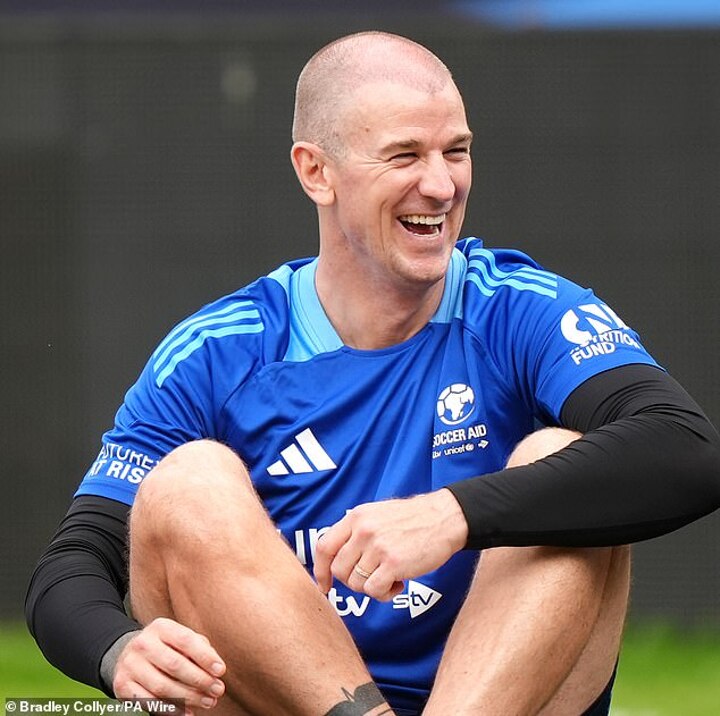

Left: Joe amid the speculation at Soccer Aid, June 2025. Right: the result on show during his coverage of the 2026 World Cup final.
Paddy McGuinness’s reaction captured that transition rather neatly.
Why reveal Joe Hart’s hair transplant now?
Because Joe was ready to.
There is no more complicated explanation.
The clinic had been aware of the speculation surrounding Joe’s hair since shortly after his procedure. Revealing the answer at the time would undoubtedly have generated considerable attention.
But that was never ours to reveal.
Patient confidentiality is not a marketing decision.
It is a professional obligation and, more importantly, a matter of trust.
Only when Joe was comfortable putting the story into the public domain did we tell it together.
In an era when almost every aspect of public life is shared immediately, there is something rather refreshing about being able to say that one of the most discussed hair transplants in British football remained exactly where it belonged for more than a year:
between the patient and his surgeon.
Who performed Joe Hart’s hair transplant?
Dr Furqan Raja performed Joe Hart’s FUE hair transplant with his surgical team in May 2025.
Dr Raja is a UK hair transplant surgeon and founder of Dr Raja Hair Restoration, providing medical and surgical hair restoration from the clinic’s Leeds headquarters and Harley Street, London.
His practice is centred on natural hair restoration, careful donor management and individually designed treatment plans rather than a standardised approach to hair transplant surgery.
Joe’s case is perhaps one of the clearest public examples of that philosophy.
Not simply because he is one of the most recognisable names in English football.
But because, despite being photographed, filmed and discussed extensively, the result was allowed to speak before the surgeon ever did.
Joe Hart hair transplant: frequently asked questions
Did Joe Hart have a hair transplant?
Yes. Joe Hart underwent an FUE hair transplant with Dr Furqan Raja and his surgical team in May 2025. Joe and the clinic publicly revealed the information for the first time in August 2026.
Who did Joe Hart’s hair transplant?
Joe Hart’s hair transplant was performed by Dr Furqan Raja, founder of Dr Raja Hair Restoration.
When did Joe Hart have his hair transplant?
Joe underwent his hair transplant in May 2025.
What type of hair transplant did Joe Hart have?
Joe underwent an FUE hair transplant, also known as Follicular Unit Extraction.
Why did people think Joe Hart had undergone a hair transplant?
Speculation intensified after Joe appeared with a closely cropped hairstyle during the summer of 2025. His changing appearance subsequently attracted discussion from the press, football supporters and hair restoration commentators.
Why wasn’t Joe Hart’s hair transplant surgeon revealed earlier?
Because Joe’s treatment was confidential.
Despite considerable public speculation surrounding his hair, Dr Raja Hair Restoration did not disclose that Joe was a patient. The clinic’s involvement was revealed only when Joe chose to share the story publicly.
Where does Dr Raja perform hair transplants?
Dr Furqan Raja treats patients through Dr Raja Hair Restoration in Leeds and on Harley Street, London, with patients travelling from across the UK and internationally for consultation and treatment.
Can I have the same hair transplant as Joe Hart?
Hair transplant surgery should never be copied from another patient.
The appropriate hairline, density and distribution of grafts depend upon individual factors including the pattern of hair loss, donor availability, hair characteristics, facial proportions, age and the likelihood of future progression.
The objective is not to recreate Joe Hart’s hair transplant on somebody else.
It is to create a result that looks entirely natural on you.