Hair restoration advice

Medically reviewed by
Dr. Raja
Hair Transplant Surgeon
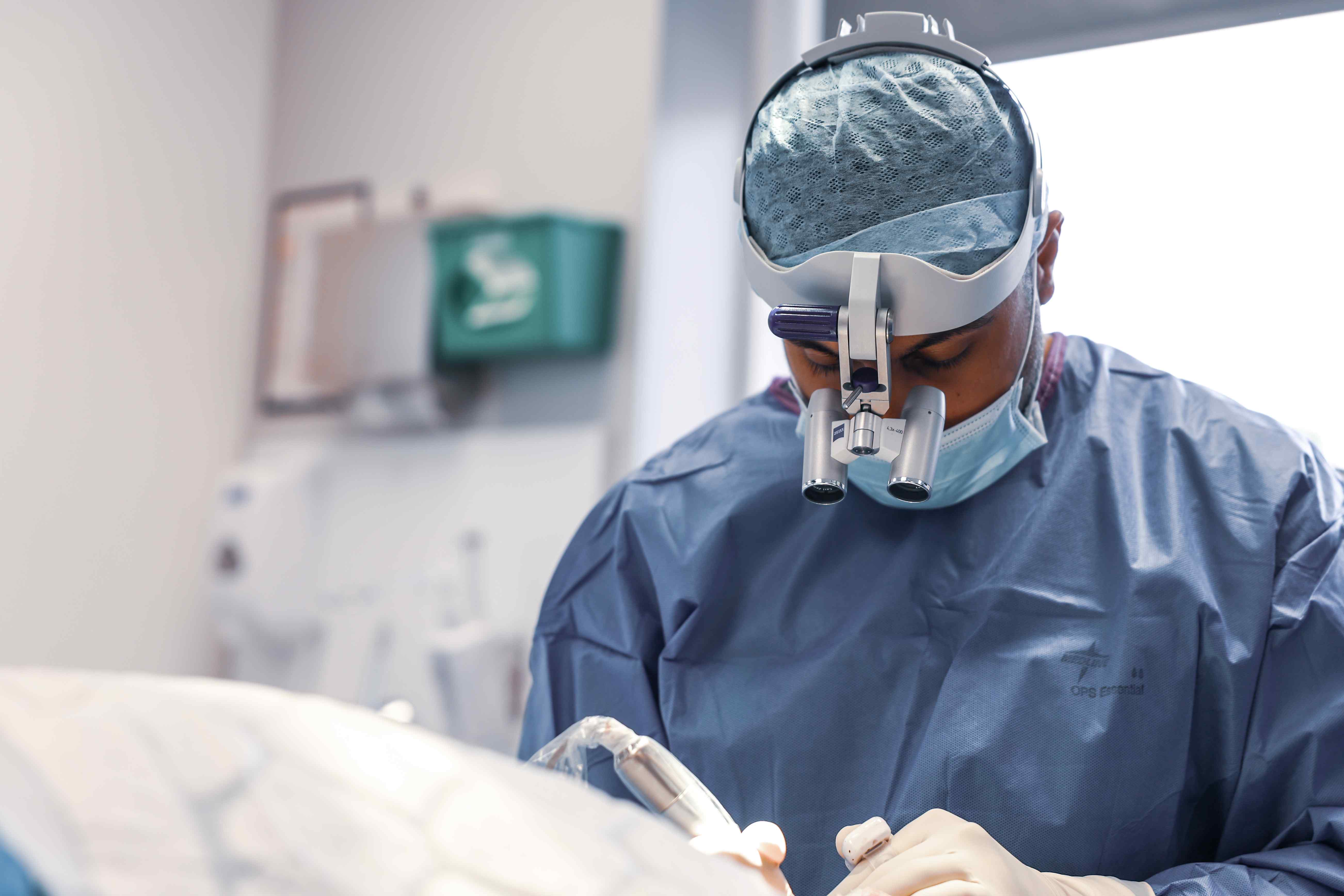
Understanding FUE and FUT Hair Transplants
Hair loss is one of the most common concerns affecting both men and women throughout the UK. Whether it presents as a receding hairline, thinning crown, widening parting, or progressive male pattern baldness, the impact can extend far beyond appearance and affect confidence, self-image, and quality of life.
Fortunately, advances in modern hair restoration have made it possible to achieve natural, long-lasting results through surgical hair transplantation. Today, the two most established techniques are Follicular Unit Extraction (FUE) and Follicular Unit Transplantation (FUT).
While both procedures can produce exceptional outcomes when performed by an experienced hair transplant surgeon, FUE has become the most sought, after option for many patients due to its minimally invasive approach, discreet healing, and versatility. However, FUT remains an important technique and can offer significant advantages in certain cases.
Understanding how these procedures differ is an essential step in choosing the right hair loss treatment and developing a personalised hair restoration plan.

Why FUE Has Become the Most Popular Hair Transplant Procedure
FUE hair transplant surgery has transformed the way hair restoration is performed. Rather than removing a strip of scalp from the donor area, individual follicular units are extracted one at a time using specialised instruments before being implanted into areas affected by hair loss. You can learn more about the differences between FUE and FUT hair transplant techniques.
This technique has become increasingly popular because it allows patients to undergo hair transplantation without the linear scar associated with traditional strip surgery.
For many individuals, this means greater flexibility when styling their hair and a more discreet recovery process. The procedure is suitable for a wide range of patients, from those experiencing early-stage hairline recession to individuals requiring more extensive restoration across the scalp.
When performed correctly, FUE can produce natural-looking results that blend seamlessly with existing hair, making it one of the most effective treatments available for male pattern baldness and selected cases of female hair loss.
Hairline Restoration and Natural Hairline Design

One of the most common reasons patients seek a hair transplant consultation is to address a receding hairline.
The hairline is often the first area affected by genetic hair loss and is also one of the most visible features of the face. Successful hairline restoration requires far more than simply adding density. It demands careful planning, artistic judgement, and an understanding of how hair naturally grows and matures over time.
FUE is particularly well suited to hairline restoration because it allows surgeons to select and place individual follicular units with exceptional precision. Single-hair grafts can be positioned along the leading edge of the hairline to create a soft, natural appearance, while larger grafts can be used behind them to provide density and support.
A well-designed hairline should complement a patient's age, facial structure, ethnicity, and future hair loss pattern. When performed by an experienced hair restoration specialist, the result should appear completely natural and undetectable.
Crown Restoration and Treating Thinning at the Vertex
Another common concern is thinning at the crown, often referred to as the vertex.
Crown restoration can be particularly challenging because hair naturally grows in a circular pattern, requiring careful graft placement to recreate the appearance of natural growth. Unlike the hairline, the crown often requires a substantial number of grafts to achieve meaningful improvement.
FUE allows surgeons to strategically distribute grafts throughout the thinning area while preserving a natural growth pattern. The goal is not simply to add hair but to create the illusion of density and improve overall scalp coverage.
Patients seeking crown restoration should understand that treatment planning is especially important, as future hair loss may continue to affect surrounding areas. A comprehensive long-term strategy helps ensure that donor hair is used effectively and sustainably.
Donor Area Management: The Foundation of Successful Hair Restoration
Every successful hair transplant begins with careful donor area management.
The donor area, typically located at the back and sides of the scalp, contains hair follicles that are genetically resistant to the effects of androgenetic alopecia. These follicles represent a finite resource and must be managed responsibly.
One of the most important responsibilities of a hair transplant surgeon is preserving the long-term integrity of the donor area. Over-harvesting can compromise future treatment options and may negatively affect overall appearance.
FUE allows for strategic extraction across a wider donor zone, helping to maintain a balanced appearance while preserving graft reserves for future procedures if required.
Effective donor management is one of the key differences between average and exceptional hair restoration outcomes.
Hair Transplant Recovery After FUE
Recovery is often a major consideration for patients researching hair transplant surgery.
One reason FUE has become so popular is the relatively straightforward healing process. Because individual grafts are extracted rather than a strip of scalp being removed, most patients experience minimal discomfort within the donor area.
Small extraction sites typically heal quickly, and many patients return to normal daily activities within a relatively short period. Temporary redness and minor scabbing are normal parts of the healing process and generally resolve as recovery progresses.
Following the procedure, transplanted hairs usually enter a shedding phase before new growth begins. This stage is entirely expected and forms part of the normal hair growth cycle.
Visible improvements often begin within several months, with results continuing to mature over the course of the first year. Patience is essential, as successful hair restoration is a gradual process rather than an immediate transformation.
FUT Hair Transplant: An Important Alternative
Although FUE receives much of the attention in modern hair transplantation, FUT remains an extremely valuable procedure and continues to play an important role in hair restoration surgery.
Follicular Unit Transplantation involves removing a carefully selected strip of donor tissue from the back of the scalp. The tissue is then dissected under stereoscopic microscopes to create individual follicular unit grafts for transplantation.
The greatest advantage of FUT is its ability to maximise graft yield while preserving follicle quality. For patients with advanced hair loss who require extensive coverage, FUT may provide access to a larger number of grafts in a single procedure.
This can be particularly beneficial for individuals seeking significant restoration across the frontal scalp, mid-scalp, and crown.
While FUT does result in a linear donor scar, this is often concealed by surrounding hair and may be an acceptable trade-off for patients whose primary goal is achieving maximum density.
When FUT May Be the Better Choice
There is no single procedure that is right for every patient.
In some cases, FUT may be recommended when:
Extensive hair loss requires a large number of grafts.
Maximum density is the primary objective.
Donor hair preservation is a key consideration.
Previous procedures have reduced available donor reserves.
Long-term restoration planning requires the most efficient use of donor hair.
For these patients, FUT can remain one of the most effective surgical options available.
Combining FUT and FUE
An often-overlooked aspect of hair restoration is that FUT and FUE do not need to be viewed as competing techniques.
Many patients benefit from a combination approach over the course of their lifetime. FUT may initially be used to maximise graft numbers, while FUE can later provide additional grafts, refine previous work, or help improve donor area appearance.
This flexibility allows surgeons to create highly personalised treatment plans tailored to the patient's current needs and future goals.
Choosing the Right Hair Restoration Specialist
Whether considering an FUE hair transplant, FUT hair transplant, or a combination of both techniques, the most important decision is selecting the right hair restoration specialist.
Successful outcomes depend on far more than the procedure itself. Hairline design, donor area management, crown restoration planning, surgical technique, and long-term strategy all play critical roles in achieving natural-looking results.
Patients should carefully review a surgeon's experience, qualifications, and hair transplant before and after results before making a decision. A thorough hair transplant consultation should assess not only current hair loss but also future progression, ensuring that every graft is used wisely.
A Long-Term Solution for Hair Loss
Modern hair transplantation offers an effective and lasting solution for many forms of hair loss. Whether addressing male pattern baldness, female hair loss, a receding hairline, or crown thinning, both FUE and FUT can deliver outstanding results when used appropriately.
For many patients, FUE has become the preferred choice because of its minimally invasive nature, rapid recovery, and natural outcomes. However, FUT continues to provide significant benefits for selected individuals requiring maximum graft yield and extensive coverage.
Ultimately, the best approach is one that is tailored to the individual. With expert planning, careful donor management, and the guidance of an experienced hair transplant surgeon, hair restoration done at our Leeds clinic can provide natural, long-term improvements that restore both hair and confidence.
About Dr. Furqan Raja
Dr Furqan Raja is a UK-based hair restoration surgeon and the founder of Dr Raja Hair Restoration, with clinics in Leeds and London. His approach focuses on personalised hair restoration, combining careful hairline design, donor area management and long-term treatment planning to achieve natural-looking results.
Dr Raja performs both FUE and FUT hair transplant procedures, tailoring the technique to each patient's individual pattern of hair loss, donor capacity and restoration goals. His work encompasses hairline and crown restoration, as well as more complex hair restoration requirements.
With a focus on surgical precision, natural aesthetics and responsible use of the donor area, Dr Raja believes that successful hair restoration should be planned for the long term, not simply focused on the immediate result.
Patients considering hair transplant surgery in London can arrange a consultation at Dr Raja Hair Restoration's Harley Street clinic.


